
Syria’s Second Battlefield
What Social Media revealed about the new mechanics of conflict

In every modern conflict, there are now two wars unfolding at the same time.
The first is fought with weapons.
The second is fought with narratives.
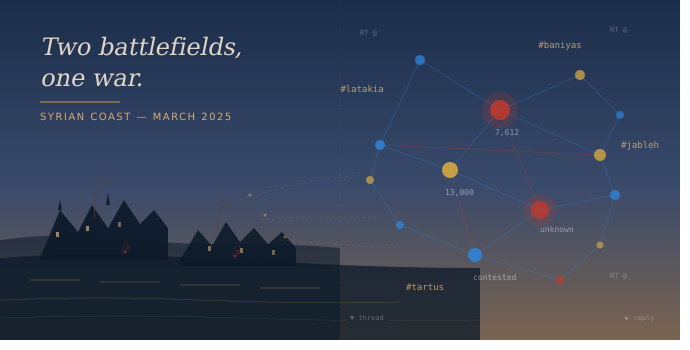
In March 2025, Syria’s coast became the site of one of the most disturbing episodes in the country’s post-Assad transition period. Civilians were killed across Latakia, Tartus, Baniyas and surrounding areas. Within hours, social media platforms became saturated with footage, accusations, sectarian narratives, casualty claims, counter-claims and coordinated messaging campaigns.
What followed was not simply an online reaction to violence. It became its own arena of conflict.
At BrainBridge Solutions, we analysed 100,000 social media posts and comments related to the Syrian coastal massacres using a large language model knowledge graph system. The result was a network containing 3,086 nodes and 22,376 relationships: a structural map of the information environment surrounding the killings.
Some of the findings were difficult to ignore.
The analysis showed that what appears chaotic on social media is often surprisingly structured beneath the surface. Narratives evolve like adaptive systems. Hate campaigns mutate into new variants. Blame attribution consolidates around some actors while remaining fiercely contested around others. Entire online ecosystems coordinate around hashtags, emotional framing and sectarian identity.
More importantly, the project suggests that future conflict escalation may depend as much on information ecosystems as on developments on the ground.
The central discovery
There is a tendency to think of disinformation as the spread of fake stories or fabricated events.
What emerged from the Syrian coastal massacres was more complicated than that.
The overwhelming majority of discourse analysed by BrainBridge Solutions was anchored to real violence. The locations dominating online discussion (Baniyas, Jableh, Latakia and Tartus) corresponded directly to documented massacre sites.
The manipulation did not come primarily from inventing events that never happened. It came from reframing real violence in ways that intensified fear, anger and sectarian division.
The same atrocity could be reframed simultaneously as:
sectarian revenge;
attempted genocide;
anti-terrorist security operations;
foreign conspiracy;
proof of historical victimhood;
or justification for retaliatory violence.
The dataset revealed that 71.7% of analysed massacre discourse contained hate speech, while 93.9% of massacre-related events were framed in sectarian or aggressive tones.
This matters because language shapes political and social behaviour. Across different conflict environments, dehumanising rhetoric has repeatedly appeared before periods of escalation. Online discourse does not simply mirror violence; it can help prepare the emotional conditions for it.
In Syria’s coastal crisis, the information environment was not calming tensions after the massacres, tt was amplifying them.
Measuring narrative consolidation
One of the most significant findings from the project was the development of actor polarisation scoring.
Rather than measuring whether an actor is simply mentioned positively or negatively, polarisation scores quantify whether blame attribution has consolidated or remains contested.
This distinction is strategically critical.
Some narratives in conflict environments become effectively settled. Others remain active battlegrounds where public perception is still fluid.
The data revealed dramatic differences between major actors in the Syrian coastal discourse.
Actor polarisation landscape
Actor Polarisation Score Interpretation
Assad Regime 0.974 Near-total blame consensus
Alawite Community 0.891 Strong solidarity framing
General Security Forces 0.840 Successful support mobilisation
Hayat Tahrir al-Sham (HTS) 0.296 Highly contested narrative
Israel 0.167 Instrumentalised rhetorical actor
The Assad Regime’s score reflected near-total narrative consolidation. Responsibility attribution had effectively closed.
HTS, however, occupied a radically different position.
The organisation’s discourse profile remained deeply contested. Approximately 64.8% of mentions attributed blame, while 35.2% framed HTS positively or defensively.
This is reflects a genuine struggle over how events are understood and remembered.
In practical terms, contested narratives create intervention windows.
Once public attribution hardens, it becomes very difficult to shift. But while narratives remain contested, there is still space for evidence, communication and intervention to influence how events are interpreted.
The broader significance is that these systems make it possible to identify not only what narratives exist, but which ones are still unsettled.
Coordinated narratives, not random outrage
Perhaps the most striking discovery in the analysis was the existence of 524 distinct coordinated discourse patterns.
This is where the research moves beyond conventional social media monitoring.
Human analysts can identify inflammatory content. What large-scale graph analysis adds is the ability to identify the structural relationships connecting thousands of separate posts into recurring narrative patterns.
The system identified:
recurring actor constellations;
repeated blame structures;
coordinated hashtag ecosystems;
recurring rhetorical pathways;
and evolving sectarian campaign variants.
Most significantly, the AI identified 22 structurally distinct sectarian hate campaign variants.
These were not simply people expressing anger in different ways.
Each variant represented a different strategic communication architecture.
Some framed Alawites as collective perpetrators.
Some framed Sunnis as collective aggressors.
Some invoked historical massacres.
Some inflated casualty claims into genocide narratives.
Some targeted Western audiences and international organisations.
Others were tailored for intra-Syrian sectarian mobilisation.
What stood out was how organised many of these campaigns appeared structurally. They adapted to different audiences, different moments and different political objectives.
A case study in coordinated messaging
One of the clearest examples of coordinated narrative engineering emerged around Syria’s General Security Forces.
The analysis detected highly organised hashtag campaigns including:
#general_security_are_not_criminals
#general_security_represents_me
#general_security_protects_us_not_kills_us
#god_protect_general_security
These campaigns achieved unusually high internal consensus scores, averaging 0.71.
But the real significance was structural.
The campaigns were effective partly because they operated on several levels at once.
They simultaneously combined:
solidarity framing,
blame redirection,
denial narratives,
moral language,
and religious legitimacy.
The hashtags were not isolated slogans. Together, they formed a coherent narrative ecosystem.
This matters because most institutional counter-narrative programmes remain painfully simplistic.
Many institutional responses to online extremism still rely on isolated factual corrections or broad appeals for calm.
The Syrian data suggests this approach is structurally inadequate.
The most effective campaigns in the dataset were not built around single messages. They combined emotion, identity, solidarity and blame into integrated narratives.
The casualty inflation problem
Another major finding involved casualty claim variance.
Different narratives surrounding the same incidents produced wildly divergent death tolls.
Some events were described as involving dozens of deaths.
Others claimed hundreds.
Others claimed thousands.
One node connected to killings in Baniyas referenced 13,000 casualties, while neighbouring narratives describing the same period reported substantially lower or unknown figures.
This was not merely confusion.
It was strategic ambiguity.
Casualty inflation performs a specific function within escalation ecosystems:
it magnifies emotional intensity;
reinforces genocide framing;
accelerates outrage;
and reduces the possibility of verification.
In highly polarised environments, uncertainty itself becomes operationally useful.
The inability to establish shared factual baselines creates conditions where emotional mobilisation outruns evidence.
What this means for conflict forecasting
Traditionally, conflict forecasting has depended heavily on field intelligence, military developments or political negotiations.
This project suggests that another layer deserves serious attention.
Information environments themselves may become measurable early-warning systems.
When hate speech spikes.
When blame attribution rapidly consolidates.
When new discourse variants emerge.
When coordinated hashtag ecosystems achieve scale.
These are not simply indicators of online toxicity, rather they may represent precursors to physical escalation.
The strategic implication is profound:
Systems like this could eventually help governments, NGOs and international organisations detect escalation dynamics earlier than traditional monitoring methods allow.
Not because they can predict the future with certainty, but because they can track the rhetorical conditions that often emerge before violence intensifies.
A different way of understanding conflict
The Syrian coastal massacres project demonstrates something larger than Syria itself.
It shows that conflict narratives are now measurable systems.
For decades, analysts have treated propaganda, sectarian discourse and online mobilisation as largely qualitative phenomena requiring manual interpretation.
That is beginning to change.
Large language models, graph databases and structural discourse analysis now make it possible to map information warfare at a scale impossible for human analysts alone.
The result is a shift towards something closer to real-time narrative analysis.
And this matters far beyond Syria.
The same methodology could be applied to:
sectarian mobilisation in Iraq;
ethnic violence in Sudan;
online incitement in Myanmar;
political radicalisation in Europe;
or coordinated hate ecosystems anywhere digital discourse shapes physical outcomes.
Online narratives are no longer peripheral to conflict environments. In many cases, they are becoming part of the conflict itself.
Final reflection
The Syrian coastal massacres produced two parallel battlefields.
One existed in streets, villages and towns.
The other existed in hashtags, narratives, emotional framing and algorithmic amplification.
The second battlefield increasingly shapes the first. That may be one of the defining characteristics of modern conflict.
Source Material
This article is based on BrainBridge Solutions’ AI-assisted analysis of 100,000 social media posts related to the March 2025 Syrian coastal massacres, conducted for the Konrad Adenauer Stiftung Lebanon programme.
Key analytical outputs included:
3,086 knowledge graph nodes
22,376 relationships
512 actor polarisation profiles
524 coordinated discourse patterns
22 structurally distinct sectarian hate campaign variants
The findings were derived through large language model knowledge graph analysis, structural co-occurrence modelling and narrative pattern extraction.
To view the full graph or ask for direct access, visit brainbridgesolutions.com
Great article.